

Celebrating 10 Years of Blue Lapis Light
The compassion and creative genius of Sally Jacques.
When people refer to Sally Jacques, it is often for the many accolades she has gained for her work. Among others, she has received the Susan B. Anthony Award for Peace, the Samsung Signature Peace Award, the 2006 Greater Austin YWCA Woman of the Year Award and the 1994 New Forms Regional Initiative Grant, which is funded by the National Endowment for the Arts, the Rockefeller Foundation and the Andy Warhol Foundation.
To say her work is innovative is an understatement. The word “genius” is bandied about and not undeservedly. I dare you to witness a Blue Lapis Light performance and remain untouched. This creative force has been bringing her original site-specific aerialdance performances to Austinites through Blue Lapis Light for 10 years. Dedicated to raising the collective consciousness about the social, political and spiritual issues that touch us all, her work is compelling and compassionate, thought provoking and inspirational, disturbing yet eloquent. Jacques is a woman deeply committed to peace in the largest sense of the word.
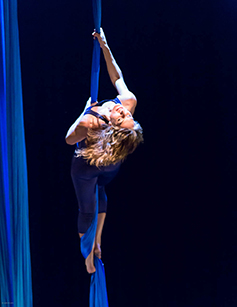 We set out to capture her spirit and her story in 10 questions, taking a look at her journey during the past 10 years.
Austin Woman: Pretend I know nothing about you and Blue Lapis Light. Who are you and what do you do?
Sally Jacques: The simple answer is that I am the founder of Blue Lapis Light, create and choreograph site-specific aerial-dance works. But what I am is a seeker on a journey to find what is purposeful with passion and would connect me with the vision of understanding and practicing compassion. As an artist, I studied with many notable people to learn how to create art that spoke to political and social issues through performance that would connect people to that compassionate concern. I named my company Blue Lapis Light because I didn’t want the name to be about me. Gandhi said when you touch the blue light in meditation, you are merging with God consciousness, which was my intent when I founded Blue Lapis Light. My work has focused on the problems of the homeless, war, rape and abuse of women, abuse of power, death and loss, which all seem very dark and hopeless. But what I try to show is the incredible beauty of life. My intent is to reflect the light that shines through these struggles and connects us to something grander and more majestic, something universally benevolent and powerful. It has always been important to me to connect with people rather than alienate people.
AW: Your work always has an overarching vision and a message. You refer to it as “prayers for the planet.”
SJ: My intention is to shine a light into the darkness and help people look at their fear. There is a point when you face your worst fears or losses that you have to find that place that moves beyond sense of self and expands your soul, allowing you to contribute in ways that are expansive and remarkable. If you don’t find a purpose or light in a dark experience, then you can literally destroy your spirit, and nothing is worse than that. Grief, anger, suffering, loss—yes, it is a terrible part of the journey, but if you are open to it, there is a moment where you begin to feel the little bit of light and can breathe in possibility. You can express your humanity in ways you never dreamed because you have been made to be more compassionate. My prayer is to create art that allows each individual in the audience to enter into that space. I want people to experience beauty in all of life’s drama. Each performance always begins with the intent of sending peace into the world.
AW: Peace is very important to you. Your role models—Gandhi, Martin Luther King Jr., Nelson Mandela, Maya Angelou, Mother Teresa— were all about peace. Define peace and what it means to you.
SJ: Peace, to me, is harmony and balance and respect for all of the species we share this planet with. You cannot be at peace without compassion for others.
AW: How do your role models exemplify peace and what it means to you?
SJ: Nelson Mandela transcended years in prison in unbelievable circumstances because he understood that if he allowed anger to destroy him, he would never be able to make the changes he knew were necessary to live in peace. That is the ultimate depth of peace and what, as a human being, you can withstand. Maya Angelou had an incredible story of abuse and yet, she became a poet, actress, writer and a teacher, and never stopped being an activist for the things she believed in. She was a joyous person, but it didn’t mean that she hadn’t experienced terrible tragedy in her life. It is all about handling life with compassion for yourself and for others. Your life shapes who you become. You can be overwhelmed by darkness or you can look to what you can give and how you can inspire others. That is always my intent. The power of peace can always defeat the power of darkness.
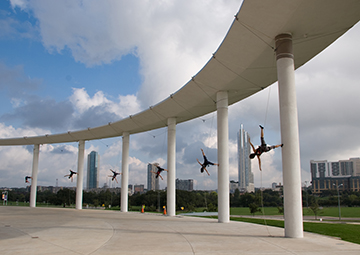 AW: Your work is site-specific. How much do you draw from location and how much do you draw from the message of your piece? Where do you find inspiration?
SJ: The thing that makes my heart sing is creating site-specific works, having a relationship with nature and the environment, as well as man-made architecture, and being able to explore the body in space. For the most part, location and message are simultaneous because I find my inspiration from within. The message has been living inside of me for a long time and it must be communicated. From that feeling, I develop the story line from the images that float around in my head. I set the intent for the vision of the piece and translate it using the site and movement.
AW: Most of your pieces are topical. Requiem was about the 2004 tsunami, 64 Beds was about the plight of the homeless, Body Count addressed AIDS awareness and Inside the Heart confronted issues relating to war. As an artist, how do you address these concerns through dance and movement?
SJ: The human body is an incredible instrument. Just by a contraction or the way you open your arm or extend your leg, you can create an emotional connection. I use movement to suggest a non-verbal poem. Nature is part of my site-specific pieces. Whether it is the full moon or cranes flying, it is bigger than anything we could do in a theater because nature is a part of it as well. These coincidental things are really part of the universal mystery, and being connected to that mystery feeds me.
AW: Your work is highly acclaimed. 64 Beds aided Help Our Brother in securing a $1 million grant for the homeless. What is the most rewarding or satisfying thing that has come from 10 years of Blue Lapis Light performances?
SJ: The most rewarding thing is the journey that allowed me to commit to living my faith, and the grace of all of the people who showed up to embrace my work and encourage me. That has been a revelation to me. When I give up resisting, those people show up and the path is clear. Resistance shuts the flow. I learned to let go and take a breath. The space opened up for other things to come in, and it has happened that way. Now I recognize and address fear and practice letting it go.
AW: You have overcome some daunting obstacles and have said you rely on prayer and meditation to get you through. How have they helped and what advice can you give others who are dealing with adversity?
SJ: Part of adversity is finding the courage within yourself to stay connected to your dream or your vision. The question you have to ask yourself is what controls your life: fear or love? Love always starts you on the path to fulfilling your dream or vision. You have to make a contribution to the world. Find purpose in something bigger than just you. There is not one way to pray or meditate. I meditate as I swim each day and I sit quietly in the night. [It’s] whatever connects you to your source individually.
AW: Looking back at the last 10 years, what are your fondest memories? SJ: The shooting star that appeared over the dancers when we were doing Requiem. The cranes and the doves that flew overhead during performances. The full moon that rose as the dancers were in midair on a building. The voices of Eliza Gilkyson and Tina Marsh as they drew the audience into the piece. It was transformative. AW: Looking forward, what’s to come for you and Blue Lapis Light?
SJ: We will celebrate the opening of our new studio with a new piece, Edge of Grace, this September. It is about recognizing grace in the midst of war and moving toward light and calmness, despite the madness of darkness, moving toward peace. I would also like to create a work in a sacred place, to show the power of peace and harmony in a troubled part of the world, possibly the Middle East.
For more information about Sally Jacques and Blue Lapis Light, visit bluelapislight.org.
Photo of Sally Jacques by Edgar Valdes. Photo of aerial dancers by Tom Athey.
 Austin Innovators Who Are Making a Difference
 Savvy Woman: Best Kept Secret



Share